 PawfullyHonest
Dog Leash Reactivity Training Plan: Distance, Timing, and Progression
Key Takeaway
Leash reactivity improves when you manage distance first and difficulty second. Most setbacks come from training too close, too soon, with inconsistent reward timing.
Related Dog Training Guides
- Main Dog Training Guide for tools and baseline obedience workflow.
- Recall Training Checklist for response reliability at distance.
- Loose Leash Consistency Checklist for pulling-reset mechanics outside trigger spikes.
- Crate Training Night Routine Plan for sleep-stability support when arousal is high.
- Dog Health Guide when stress and pain may be behavior amplifiers.
Leash reactivity often looks like stubborn behavior, but it is usually an over-threshold response pattern: barking, lunging, whining, or fixating when another dog, person, bike, or sound appears too close. The leash can add frustration because movement feels restricted while arousal rises.
This plan focuses on controllable variables: distance, timing, repetition quality, and trigger intensity. You do not need perfect environments, but you do need predictable session structure. Pair it with our loose leash consistency checklist when leash pressure is also habit-driven between trigger events.
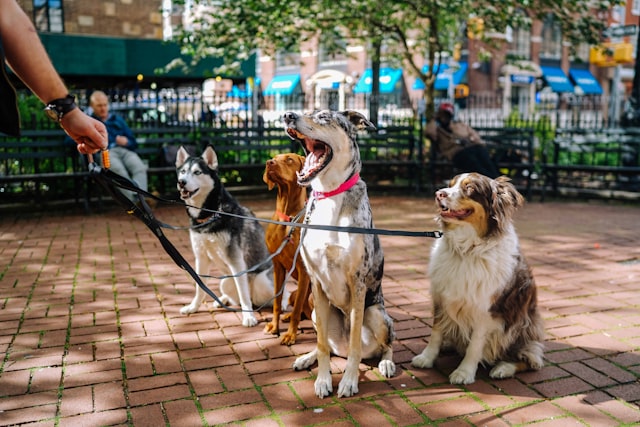
What Leash Reactivity Usually Means
Reactivity can be driven by fear, frustration, over-arousal, or a mixed pattern. The same outward behavior can have different causes, which is why intensity tracking matters more than labels.
- Fear profile: startle, retreat-then-lunge, body tension, low food interest.
- Frustration profile: strong forward pull, rapid vocalization, bounce-lunge pattern.
- Mixed profile: trigger-dependent switching between concern and overexcitement.
Your training objective is not to suppress behavior in the moment; it is to increase trigger tolerance while preserving decision-making ability.
Setup: Gear, Environment, and Session Rules
- Use stable gear: front-clip or balanced harness plus non-retractable leash.
- Pick lower-traffic training windows: reduce surprise trigger density.
- Keep sessions short: 8-15 minutes beats long high-stress walks.
- Bring high-value rewards: fast-delivery treat pouch required.
- End before escalation: preserve training quality and avoid rehearsal of meltdowns.
Initial success comes from cleaner setups, not harder exposure.
Finding and Using Threshold Distance
Threshold distance is where your dog can notice a trigger and still respond. You can test it with three checks:
- Takes food quickly
- Can orient back to you on cue
- Body can disengage from trigger within a few seconds
If one check fails, increase distance immediately. Training inside the failure zone mostly rehearses reactivity.

4-Week Progression Framework
Week 1: Stability and Patterning
- Work at easy distances only.
- Mark and reward every calm trigger check-in.
- Prioritize smooth exits over close passes.
Week 2: Controlled Movement
- Add predictable moving triggers at conservative range.
- Use turn-away and arc-walk patterns before escalation.
- Track recovery speed after each exposure.
Week 3: Real-World Variability
- Increase context variety while preserving threshold rules.
- Shorten distance only after repeated success.
- Keep reward rate high in new environments.
Week 4: Consolidation
- Blend easier and moderate setups in same week.
- Maintain high success ratio over challenge intensity.
- Build recovery and default-focus routines.
Progress is non-linear. Temporary regressions are expected when trigger density or context shifts abruptly.
Common Mistakes That Stall Progress
- Training at distances where food and cues no longer work.
- Extending session length after early signs of overload.
- Switching protocols every few days without measurable criteria.
- Using punitive corrections that raise baseline stress.
- Skipping decompression days between high-trigger outings.
If reactivity intensity is escalating despite structured work, involve a qualified professional trainer or veterinary behavior specialist.

Frequently Asked Questions
Is leash reactivity the same as aggression?
Not always. Many reactive dogs are socially conflicted or frustrated rather than intent on harm.
Can group classes help reactive dogs?
Some dogs benefit, but only if distance can be managed and class structure prevents repeated trigger flooding.
Should I avoid all trigger exposure?
No. Controlled exposure at workable distances is key; uncontrolled close exposure usually backfires.
How do I measure progress objectively?
Track threshold distance, recovery time, food responsiveness, and trigger-count tolerance per session.