 PawfullyHonest
Dog Training Whistle: The Complete Dog Training Guide
Key Takeaway
A dog training whistle is one of the most effective tools for reliable recall and distance commands — it produces a consistent tone that carries farther than your voice and never sounds angry or frustrated. This guide covers every essential training tool (whistles, leashes, harnesses, treat pouches, potty bells), proven training methods (hand signals, crate training, potty training in 7 days), the best training books, and real costs for professional and service dog training.
Related Training Checklists
- Dog Recall Training Checklist for distance reliability and distraction progression.
- Dog Leash Reactivity Training Plan for trigger-threshold and decompression work.
- Puppy Biting Training Plan for a 14-day nipping reset and bite-inhibition routine.
- Dog Loose Leash Consistency Checklist for pulling-reset rules and repeatable walk structure.
- Dog Crate Training Night Routine Plan for bedtime structure and overnight wake handling.
- Dog Health Guide for behavior patterns tied to stress, pain, or over-arousal.
A dog training whistle is the single most underutilized tool in the average dog owner's kit. Unlike verbal commands — which vary in tone, volume, and emotional charge depending on your mood — a whistle produces an identical sound every time. Dogs respond to consistency, and a whistle delivers exactly that. Professional gun dog trainers, search and rescue handlers, and sheepdog trialists have relied on whistles for centuries, and the same principles work perfectly for everyday pet training.
But a whistle is just one piece of the training puzzle. Effective dog training combines the right tools, the right methods, and the right timing. This guide covers every essential tool a dog owner needs, from training leashes and harnesses to treat pouches and potty bells. We also break down proven training methods, recommend the best training books, and provide honest cost breakdowns for professional and service dog training. Whether you are working with a new puppy or an adult dog with behavioral challenges, the equipment and techniques below will help you build a well-trained, confident companion. If your biggest issue is nipping at home, start with our puppy biting training plan. If reliability or leash behavior is the blocker, use our recall checklist, leash reactivity plan, loose leash consistency checklist, and crate training night routine plan.

The most important thing to understand about dog training is that every interaction with your dog is a training moment. Dogs learn constantly — not just during formal sessions. The tools below help you communicate clearly so your dog understands exactly what you want, every time. For breed-specific training considerations, our dog breeds guide covers temperament traits that influence trainability across all breeds.
How to Train Your Dog with a Whistle
A dog training whistle works because it cuts through environmental noise, carries over long distances (up to half a mile in open terrain), and produces a sound that never conveys frustration or impatience the way a human voice can. When you are stressed, your verbal recall command changes — it gets louder, higher-pitched, and more urgent. Dogs read that emotional shift and may hesitate to return to an upset owner. A whistle eliminates this variable entirely.
The two main types of dog training whistles are pealess whistles (like the Acme 210.5 and Acme 211.5) and adjustable frequency whistles (like the Acme 535 Silent). Pealess whistles have no moving parts, work reliably in wet and cold conditions, and produce a fixed frequency. Adjustable whistles let you dial in a specific pitch — useful if you train multiple dogs and want each to respond to a different frequency. Most trainers prefer pealess whistles for their reliability and consistency.
To train whistle recall, follow this sequence: blow one short pip and immediately deliver a high-value treat (freeze-dried liver or chicken works well — see our dog treat pouch guide for carrying options). Repeat 20-30 times per session for 3-5 days until your dog snaps to attention at the whistle sound. Then begin adding distance: whistle, reward when your dog comes to you, gradually increase the distance. Standard whistle commands are one long blast for recall, two short pips for sit/stop, and three pips for change direction. For a week-by-week drill ladder, use our dog recall training checklist.
Using Hand Signals Alongside Whistle Commands
Dog training hand signals complement whistle commands for situations where your dog can see you but may not hear you clearly. Dogs are naturally visual communicators — they read body language far more fluently than spoken language. Standard hand signals include an open palm raised to shoulder height for sit, a palm sweeping downward to the ground for down, a beckoning hand motion toward your body for come, a flat palm facing the dog for stay, and a finger point for directional commands. Pair each hand signal with its verbal command initially, then gradually fade the verbal cue until your dog responds to the visual signal alone. Deaf dogs rely entirely on hand signals, proving that visual commands can replace verbal ones completely.
Choosing the Right Training Leash
A dog training leash is the most fundamental piece of equipment you will use, and choosing the wrong type actively undermines your training goals. The number one rule: do not use a retractable leash for training. Retractable leashes teach dogs that pulling creates more freedom — the exact opposite of what you want. They also provide zero feedback control, making it impossible to deliver timely leash corrections or guide your dog into proper position. If your dog lunges or barks on walks, pair this setup advice with our leash reactivity training plan.
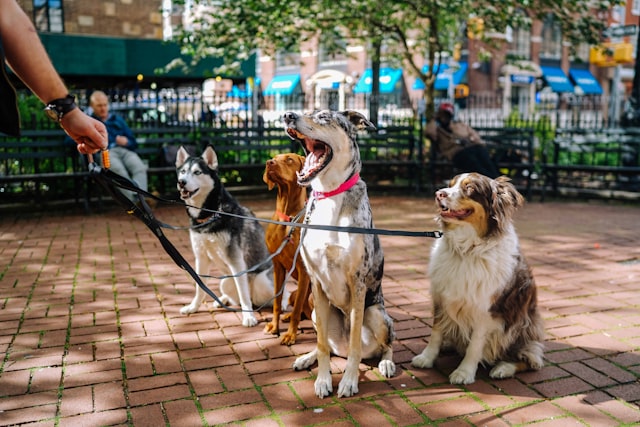
For everyday training and walking, a 6-foot flat nylon or leather leash in 3/4-inch to 1-inch width provides the best balance of control and comfort. Leather leashes are gentler on hands and develop a comfortable grip over time, but nylon is more affordable and weather-resistant. For recall training and distance work, a 15-30 foot long line gives your dog freedom to roam while maintaining a physical connection. Biothane long lines are ideal — they are waterproof, dirt-resistant, and do not tangle like nylon rope.
Harnesses That Help With Pulling
A dog training harness redirects pulling force away from the neck and distributes it across the chest and shoulders. Front-clip harnesses like the Freedom No-Pull, PetSafe Easy Walk, and Ruffwear Front Range redirect your dog's forward momentum to the side when they pull, naturally discouraging the behavior without any correction. Back-clip harnesses are comfortable but actually encourage pulling (sled dogs wear back-clip harnesses for this exact reason). For serious pullers, the Balance Harness and the Blue-9 BFFL harness combine front and back clip options with a dual-point leash attachment that gives you maximum control. Always ensure a harness fits snugly without chafing — you should be able to slip two fingers between the harness and your dog's body at any point.
Essential Dog Training Tools
Beyond whistles, leashes, and harnesses, several dog training tools make sessions more effective and rewarding for both you and your dog. The tools below represent what professional trainers actually use daily — not gimmicks, but practical equipment that solves real training challenges.
Why Every Trainer Needs a Treat Pouch
A dog training treat pouch allows instant reward delivery, which is critical because timing determines whether your dog connects the reward to the desired behavior. Professional trainers consider a treat pouch as essential as the leash itself. The best pouches feature a wide magnetic or hinge opening (not drawstring — too slow), a secure closure during movement, a belt clip or waistband attachment for hands-free carrying, and a washable interior. The PetSafe Treat Pouch Sport ($12-15), Doggone Good Rapid Rewards ($20-25), and RUFFWEAR Treat Trader ($25-30) are the top choices used by working trainers. Fill it with small, smelly, high-value training treats that your dog does not get at any other time.
Teaching Your Dog to Ring a Potty Bell
A dog potty training bell hangs on the door your dog uses to go outside and teaches them to signal when they need to eliminate. This simple tool prevents accidents by giving your dog a way to communicate a need that they otherwise express by pacing, whining, or — worst case — having an accident. To train bell use, ring the bell yourself every time you take your dog outside to potty. After 1-2 weeks, your dog will begin nudging the bell independently. The Caldwell's Pet Supply Potty Bells and Mighty Paw Tinkle Bells are popular, durable options. Hang them at your dog's nose height and replace them when the sound becomes muffled from wear.
Specialized Training Vests and Their Uses
Beyond walking harnesses, specialized training vests serve specific purposes. Service dog training vests identify working dogs and include handle attachments for mobility assistance. Weighted training vests add resistance for conditioning athletic or high-energy breeds — though these should only be used under veterinary guidance and at no more than 10% of the dog's body weight. Reflective training vests improve visibility during early morning or evening training sessions. For dogs in active training, a simple "In Training" or "Do Not Pet" vest communicates to the public that your dog is working and should not be distracted.
The Best Dog Training Books Worth Reading
Dog training books provide the theoretical foundation that makes practical training more effective. Understanding why dogs behave the way they do transforms you from someone who follows instructions into someone who can adapt techniques to your specific dog's personality and challenges. The books below represent the best current thinking in canine behavior science and practical training methodology.
"The Other End of the Leash" by Patricia McConnell examines dog-human communication from a behavioral science perspective and is essential reading for understanding how your body language affects your dog. "Don't Shoot the Dog" by Karen Pryor is the foundational text on operant conditioning and clicker training. "The Culture Clash" by Jean Donaldson challenges common misconceptions about dog behavior and dominance theory. For puppy-specific guidance, "Perfect Puppy in 7 Days" by Sophia Yin provides a structured first-week training plan. And "Decoding Your Dog" by the American College of Veterinary Behaviorists offers peer-reviewed insights into behavior problems and solutions. These books complement hands-on training — read them between sessions to deepen your understanding of what is happening during each exercise.
How to Toilet Train a Puppy in 7 Days
Toilet training a puppy in 7 days is achievable with intensive, consistent supervision. The method works because puppies naturally avoid soiling their sleeping area — by managing their environment tightly for one week, you establish the habit of eliminating outdoors before accidents become a pattern. Here is the day-by-day approach.
Days 1-2: Take your puppy outside every 30 minutes while awake, plus immediately after eating, drinking, napping, and playing. Stand quietly in the designated potty area and wait up to 5 minutes. When your puppy eliminates outside, praise enthusiastically and deliver a treat within 2 seconds. When inside, keep your puppy within arm's reach or in a crate. Days 3-4: Extend the interval to 45-60 minutes. Your puppy should be starting to show pre-elimination signals (sniffing, circling, moving toward the door). Reward every outdoor elimination. Days 5-7: Extend to 90-minute intervals. Begin teaching a potty bell or door signal. By day 7, most puppies are actively seeking the door when they need to go. Continue rewarding for 2-3 more weeks to solidify the habit, then gradually phase out treats while maintaining verbal praise.
Small Breeds That Are Easiest to Train
The easiest trained small dogs combine intelligence, eagerness to please, and food motivation — the three traits that accelerate any training program. Miniature Poodles are widely considered the easiest small breed to train, with intelligence rivaling their Standard Poodle relatives. Papillons are surprisingly sharp and excel in agility and obedience competitions. Shetland Sheepdogs (small but not tiny at 15-25 pounds) are herding dogs with strong work ethic and responsiveness. Miniature Schnauzers are eager learners with strong focus. And Cavalier King Charles Spaniels, while not the fastest learners, are exceptionally willing and gentle — they compensate for moderate intelligence with outstanding temperament. For more breed-specific insights, explore our comprehensive breed guide which covers trainability ratings for every popular breed.
Training with a Shock Collar for Dogs
Training with a shock collar for dogs is one of the most debated topics in the dog training world. E-collars (electronic collars) deliver a static stimulation to the dog's neck, ranging from a barely perceptible tingle to a painful shock. Modern e-collars also include vibration and tone-only modes that many trainers use exclusively, avoiding static stimulation entirely.
The scientific evidence leans against shock-based training. A 2020 study published in the Journal of Veterinary Behavior found that dogs trained with e-collars showed more stress-related behaviors (lip licking, yawning, body shaking) than dogs trained with positive reinforcement — and the positive reinforcement group achieved equivalent training outcomes. The American Veterinary Society of Animal Behavior (AVSAB) officially recommends against the use of aversive training methods including shock collars. Several countries, including the UK, have banned their use.
If you choose to use an e-collar despite these concerns, critical safety guidelines apply: never use one on a puppy under 6 months, always start at the lowest perceptible stimulation level, never use the collar in anger or frustration, and work with a certified professional trainer who can ensure proper timing and technique. The collar should be a communication tool, not a punishment device. Many professional trainers who use e-collars rely primarily on the vibration and tone modes, using static stimulation only as a last resort for life-safety situations like snake avoidance training. Proper nutrition supports calm behavior during training — see our best dog food guide for recommendations on feeding active dogs in training programs.
How Much Does Service Dog Training Cost?
Service dog training cost varies dramatically depending on the training pathway, the type of service required, and the organization involved. Understanding the full cost landscape helps prospective service dog handlers make informed decisions about the best approach for their situation and budget.
Professional program-trained service dogs cost $15,000-$50,000 when obtained through established organizations. Guide dogs for the visually impaired are often provided free of charge by nonprofit organizations like Guide Dogs for the Blind and The Seeing Eye, though wait times can be 1-2 years. Psychiatric service dogs typically cost $20,000-$30,000 through programs like Little Angels Service Dogs. Mobility assistance dogs range from $15,000-$40,000 depending on the complexity of tasks required. Diabetic alert dogs are among the most expensive at $25,000-$50,000 due to specialized scent detection training.
Owner-trained service dogs offer a more affordable alternative at $5,000-$10,000 total, which covers professional guidance from a certified service dog trainer, specialized equipment (harnesses, vests, task-specific gear), veterinary clearances, and public access training. The tradeoff is significant time investment — owner-training typically requires 1-2 years of consistent daily work. Proper grooming and maintenance is also essential for service dogs who must present well in public access settings.
Frequently Asked Questions
How do you use a dog training whistle?
A dog training whistle works by producing a consistent, far-reaching tone that dogs respond to more reliably than voice commands. Start by associating the whistle with a high-value treat — blow a short pip and immediately reward. Repeat 20-30 times over several sessions until your dog looks at you expectantly when hearing the whistle. Then use the whistle for recall: one long blast means "come," two short pips mean "sit," three pips mean "change direction." Consistency is key — always use the same pattern for the same command.
What is the best dog training leash for beginners?
The best dog training leash for beginners is a 6-foot flat nylon or leather leash. Avoid retractable leashes for training — they teach dogs to pull because extending the leash rewards forward movement. A standard 6-foot leash gives enough freedom for walking while maintaining control. For advanced training like recall practice, upgrade to a 15-30 foot long line that gives distance without losing connection.
How long does it take to toilet train a puppy?
Most puppies can be reliably toilet trained in 4-6 months, though some may take up to a year. The fastest method takes about 7 days of intensive supervision: take your puppy outside every 30-60 minutes, immediately after meals, naps, and play, and reward every successful outdoor elimination. Crate training accelerates the process because puppies naturally avoid soiling their sleeping area.
Are shock collars safe for dog training?
Shock collars (e-collars) are controversial and most veterinary behaviorists advise against them. Studies show that punishment-based training increases stress, fear, and aggression in dogs. Modern e-collars offer vibration and tone modes that are less aversive than static shock, but positive reinforcement methods achieve equal or better results without risk of fallout. If you use an e-collar, work with a certified professional trainer.
How much does service dog training cost?
Service dog training costs between $15,000 and $50,000 when done through a professional organization. Owner-trained service dogs cost significantly less — typically $5,000-$10,000 for professional guidance, equipment, and certification. Some nonprofit organizations provide fully trained service dogs at no cost to qualifying individuals, though wait times can be 1-2 years.